Sunday, October 6, 2013

Jo Ramirez ignores significant facts of the life of Ayrton Senna

Jo Ramirez, ex Team Coordinator (Logistics) of the McLaren team from 1984 until 2001, gave several interviews in 2010, prior to the world release of the movie-documentary "Senna", by Asif Kapadia. In those interviews, suprisingly, Ramirez stated some false assumptions about Senna's life, including some remarkable mistakes of what happened at Imola 1994 and Senna's private life. Surprisingly because Ramirez is mentioned as one of the sources when it comes to Senna's life, but his statements are for the most part inaccurate.

--- Interview for a Mexican newspaper - 2010---

After many sporting events, television cameras chase the protagonists to plant a microphone in front of them, ask questions to the heroes of the day. But despite the coverage (many of them are not exactly good at making statements), the fact that you watch all the races or matched, analyze each match, all interviews, all the repetitions, you can not say that because you have watched it, you already know everything about the spirit of the sport and the driver.

Ayrton Senna goes to take a look at the Canadian track, 1992, behind him, Jo Ramirez

The magic is still reserved for the movies.

This is exactly what happens with "Senna" , Asif Kapadia 's documentary about the legendary Brazilian Formula 1 driver. The documentary focuses on the driver, not the person, addicted to the speed, but more so, obsessed with the triumph. A fearless man , who made out of his art a religion .

This fascinating story of obsession, triumph and tragedy had a witness close to us : " Jo " Ramirez .

Contrary to what one might think , the lives of the people involved in the race are not as glamorous as it seems . JoaquĆ­n " Jo " Ramirez , a native of Mexico Narvarte- Mexico City, entered the motorsport by the back door : cleaning workshops at Ferrari , washing the cars , ordering the tools , sleeping whenever he could , eating there.

On the way , he met and befriended great racing legends such as Jackie Stewart , Mika Hakkinen , Alain Prost and, of course, Ayrton Senna .

Before the premiere of the documentary about Senna , we talked with Jo Ramirez about his colleague, Ayrton Senna da Silva . This is the interview.

- How did you meet Senna?


- I met him when he had just arrived in Brazil, I was working for Fittipaldi and he raced in Formula Ford. Emerson was the one who introduced me to him, and the three talked. Emerson said, "watch carefuly because this boy is going to be one of the greatest in history." Still, Emerson didn't imagined at that time that Ayrton would become so great.

Actually Jo Ramirez was just a Logistics Assistant at McLaren, never more than that to Ayrton Senna. He wasn't a personal friend of Ayrton Senna and only knew him within the working relationship. This is the reason why Jo Ramirez ignores many important facts of the life of Ayrton Senna, of course of his private life, but what is more striking, is that Ramirez also seems to mistake many important facts of his public life. He makes some very significant errors when he talks about Senna in this interview. These are the reasons why Jo Ramirez can not be regarded as a reliable source of information about the life of Ayrton Senna.

- Senna, the documentary mentions that his hunger for speed was almost religious, how would you describe the need for speed?

- Speed ​​is our business, Senna was born to drive cars, I've never seen someone who is so passionately dedicated to a sport. He was very diligent at work, nothing was given him free. For example, everyone knows how good he was when the track was wet, but he trained very hard; when it started to rain, he drew his kart and practiced. He was a phenomenon, a man destined to win.

Ayrton Senna, after winning the Monaco GP in 1992, is welcomed by his team members Josef Leberer - left - and Jo Ramirez - right -

- The Senna - Prost rivalry was really as big as it looks in the film ?

- Yes, it was very difficult to manage both, but it was the price of having two big stars, rather than having two guys who can not drive. The truth is that the two respected each other and Ayrton became an obsession for Prost. In the documentary Prost appeared as a villain and I disagree with this perception, in fact both were complementary, great rivalry made ​​both. I believe that if Senna had not died , the two would have been good friends. One thing : the day before his death, Senna ate with Prost.

False : once again, Jo Ramirez shows he has no rigour when he reports the facts. He probably only speaks of what he heard and not what he saw in person . He distort the facts. Senna did not "eat " with Alain Prost on the day before he died. Actually Ayrton Senna saw Alain Prost in the Renault motorhome restaurant and went to sit beside him , without saying a word. He remained there for a long time without saying a single word ( source: book " The life of Senna , Tom Rubython), not eating. This is what Alain Prost says, who knows better about his own life than Jo Ramirez, who at McLaren was working as a logistics assistant, not as a personal friend of Senna. And what is more important : this did not happen "one day before Senna died," but on the same day of his death, at noon. Prost was eating at the restaurant in the Renault motorbox and Senna went there not to eat with him, but just sat there for a few moments, perhaps trying to calm down before the race and after the death of Ratzenberger. The truth is that Alain Prost was a great motivation to Senna during his career and that's what Senna was missing in Formula 1 at the start of the 1994 season.

- The documentary projects the image of a Senna obsessed not for the podium , but with the glory to come first, as you have experienced this obsession to get as close to him ?

- It is true that Ayrton was obsessed with victory. Generally he was not happy in second or third place. But he also liked to take some distance from it, I remember one occasion he had a bad start, began to overtake and pass, and finished third. He was very pleased with the result, despite not getting on the first position . What motivated him was competition, competing to win, always .

Jo is contradicting himself here. If what motivated Senna was winning (as everyone knows), competing and arriving in 3rd position wasn't just enough for him. This occasion when Senna got third and was happy about it it was in the 1991 season, when he knew he didn't have the best car, since the Williams were, and therefore, he could not sacrifice an entire race just for the sake of winning, but managed to calm himself down and realise that points were points after all. Otherwise, from a pure personal point of view about racing, Senna has said that what motivated him was exclusively winning, not just competing... "Winning is the most important thing. That story that competing is the most important is not true." 

Ayrton Senna receives a tribute from the McLaren team, at the farewell party after the Australian GP in 1993
- There is something in the documentary that you dislike, or feel that is not exact?

- The fact that Prost is seen almost as a villain and as I said before, in fact, both had a lot of respect for each other. Prost was never an obsession for Ayrton. In fact , the only driver that Senna really feared was Terry Fulerton, a driver from his days in karting. I did not like that much in the documentary that Xuxa is in it. It was a passage in the life of Senna , but it was not her, with whom he was going to marry, he would marry his last girlfriend, Adrian Galisteu, but the family did not give permission to have her in the film .

There are many inaccuracies in this answer... First of all: it's false that Alain Prost was never an obsession for Ayrton Senna. All friends, family and experts in Formula 1 and even Alain Prost, say that Ayrton Senna was obsessed with Prost, in the sense that Senna wanted to beat Prost, while Prost did not care too much about Senna. Senna, on the other hand, arrived at the McLaren team with only one idea in mind : to destroy Prost in his own territory, and so he did . That's why Senna lost part of his motivation during the 1994 season, when Prost retired, and that's why he said that phrase on French television on Sunday, May 1, 1994 : "Alain , I miss you." Again, Jo Ramirez proves that he knew nothing about the real facts of the life of Senna , despite being close to him in the McLaren team. 


And it's also false that Ayrton Senna was going to marry the brazilian model, Adriane Galisteu. Senna himself had stated just a month before his death in an interview to the Brazilian magazine "Caras" that he did not intend to marry her, and showed a quite reluctant attitude towards his girlfriend, Adriane Galisteu. He said in that interview that he had not yet found the right woman to marry, he refused to mention Adriane as his girlfriend, and he said he wanted to look around for other women to find someone better. Many interpret this interview in the magazine Caras as the first step that Ayrton Senna gave in order to break up with Adriane Galisteu. Senna was disappointed with her for her vulgar photos in the same magazine, Caras, made ​​in February 1994, where she posed in some very embarassing poses. He felt deeply humiliated and gave an interview a month before his death 
where he said that  "you can not always be with the person you love" referring to his former girlfriend Xuxa.

It is also false that Adriane Galisteu did not appear in the film "Senna" of Asif Kapadia. She does appear, although very briefly, only a few seconds: she can be seen on the back of the motorbike Ayrton in Monaco 1993, the first time he took her with him to the Formula 1 circuits. Now, given the paramount importance of Xuxa in the life of Ayrton, as he had said numerous times, stating that she was the love of his life, and not Adriane , it is obvious that Xuxa deserved more time in the film than Adriane Galisteu. Ayrton spent over three years with Xuxa and only 13 months with Adriane Galisteu. Ayrton always stated that Xuxa was his true love, and he never said anything about loving Adriane Galisteu. The only person who says he was in love with her was Adriane herself. In the book she wrote only 5 months after Senna's death to make money. Adriane was more of a partner during the Formula 1 season for Senna, rather than a "big love". This is proved by the words of Ayrton Senna in several interviews, on television and in the press . He never said Adriane Galisteu was a possible future wife and those closest to him, like his friends or family, deny that. 


- You were there the day of the accident that killed Senna. Jo Ramirez: how did you spent that day?

- After the accident, I did not know anything. Obviously, they stopped the race, I kept doing routine things to finish, but I have not heard the news or anything. Inside I was convinced that he would not die, he was out of danger ... in some manner.


- What do you think is the legacy of Senna?

- Senna took Formula 1 to a new level. He showed that it was possible to do more, no matter the conditions. It is important that his legacy and his memory are known.

Source: http://blogs.eluniversal.com.mx/wweblogs_detalle.php?p_fecha=2011-08-19&p_id_blog=78&p_id_tema=14592

Saturday, October 5, 2013

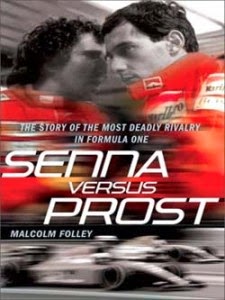
One of the worst books on Ayrton Senna ever: "Senna vs Prost" by Malcolm Folley

Undoubtedly one of the worst books written about Ayrton Senna, is this one, released by the publisher Arrow in May 2010, anticipating the huge free promotion that the book would have as a result of the release of the movie "Senna" by Asif Kapadia, in November that same year.


Biased, partial, inaccurate, repetitive, disrespectful, "a masterpiece in Senna bashing", "full of lies"...  are only some of the adjectives and expressions used by actual readers to qualify the book "Senna vs Prost" written by Malcolm Folley, that nothing adds to Senna's already told history, and only very little to Prost's, since the only new piece of material is an interview with Alain Prost, nothing too exciting though.

THE ONLY BOOK WHERE MICHAEL ANDRETTI IS A FORMULA 1 CHAMPION...

A true anti-Senna book, on the other hand. Moreover, the book is quite badly researched or edited, since many facts of Senna's life are simply not true nor the account of them is accurate nor trustworthy. The author seems to not have much idea about Senna's life, not the interest in doing well his homeworks before putting himself to "write" the text. The book is so inaccurate that it's the only place where Michael Andretti has become a World Champion in Formula 1!! How about that accuracy? This series of factual inaccuracies end up casting doubt over the new material. In particular, the claim that Lotus made a world champion out of the perennially under-performing Michael Andretti (who once dawdled about in a McLaren) jumps off the page. In fact it was Michael's father Mario, a generation before, that was F1 world champion.


The book seems highly opportunistic of the time when it was released, just a few months before the release of the movie "Senna" by Asif Kapadia, a "nice" try ofits author, Malcolm Follwy to cash some money repeating texts entirely extracted from other books, like Tom Rubython's or Adriane Galisteu's (not a very reliable source of information, either, since she's better known in Brazil for having a very colorful imagination, changing her version of the facts depending on what best arranges her each time).

In short: a waste of time and money, you better go and choose some other books.

Here some of the reviews of readers found on Amazon:

1.0 out of 5 stars LIESNovember 2, 2009
By 
Hank Cnaski 


If you have seen the Grand Prix of Monaco in 1984 and the Portuguese GP in 1988 yourself, then buy the book and tell the author, what a liar he is! Authors should not get away with lies like this, just because it's a a long time ago, so the author thinks he can write plain lies, even tough the truth is documented. First time I read a book so full of plain lies! If you like this book, then you can as well buy a book about "The Holocaust never happened" . Unbelievable how somebody can have the guts to publish such stupied lies. This book is for anybody, who didn't actually see the races. I have nothing but disgust for such an "author".

1.0 out of 5 stars
Disgusting18 April 2013
By 
reveller74 
This review is from: Senna Versus Prost (Paperback)
The book does not live up to it's title: Senna vs. Prost only takes place after the half of the 400 pages. Only then the author has arrived at 1988. Everything until then describes the F1 seasons 1980 - 1987, resp. basks in British motorsport history. In school they would say "missed the point!". But it gets really bad when he misses interesting moments in the history of their rivalry, such as the temporary conciliation at the press conference after Monza 1990.

Someone could not expect a beatification of Senna here. But - in the tradition of many English Senna-Books - this is a masterpiece in Senna bashing. He really must have been a hate-figure in England. There are some exceptions, of course, for example the books of Christoper Hilton. But there are really bad things, e.g. "The death of Ayrton Senna" by Richard Williams or the mocking "The Messiah of Motor Racing" by Richard Craig.

When the author arrives at 1988, Prost was already introduced as a superior super-driver, who manages all critical situations easily, the book is also 80% Prost in a quantitative sense. Senna is presented as a spoilt brad with a rich family behind him, who blasts everyone ruthlessly off the track and who whines and cries, if thinigs not go well.

There's no objectivity in this book at all: A more or less up-to-date interview with Prost is mentioned all the time, while many of Sennas opinions, that are very well existing, were skipped or were given along the way, after Prosts version was almost introduced as a fact.

Someone is reminded to Sennas press conference after Suzuka 1988: I was treated like a criminal ... responsible for everything." The author digs out some interesting opinions: Responsible for Mansells accident in Suzuka 1991 was - Senna! And he was grinning in the cockpit after that. How could he know that and what has this to do with journalism? Senna was criticised for his voting against Warwick in 1986. So was Prost criticised for his voting against Senna in 1993? No! It was SENNA who was the bad boy again! Why? He pushed Prost out of his contract in 1994!

Well, this book is Prosts story telling time.

And of course Senna is responsible for his own death. The only opinion to this matter featured here is that of Damon Hill (not known as a Senna fan as well). Other arguments were not mentioned ("useless"). Senna was also criticised for his statement about dangers in motor racing ("Either you have to face it in a professional way or just drop it."). Sarcastically that quote is mentioned with the conclusion, that he couldn't live up to his own big words when he was faced with death (Ratzenberger) on the track.

Conclusion: Utter crap!


1.0 out of 5 stars A Love Song for ProstSeptember 8, 2012
By 
Evangeline Nola 


This is not a balanced account of one of the most dramatic episodes in F1 racing. It reads like a fan book written by an author completely besotted with Prost. It is also a character assasination of Senna, with the author hand picking and pruning interviews and events to paint Senna in the worst light possible. The author makes assumptions about what Senna's motives were or what his 'true' personal ethics were without consulting people who could speak for Senna. Example? The author claims that Senna ruthlessly divorced his wife when she became an inconvenience for him. Huh? Senna and his wife were childhood sweethearts, married as soon as they were of age, and deeply loved each other. But it was NOT Senna who ended the marriage. Senna's wife could not endure the loneliness of a life lived traveling between racing circuits, nor the intense fear racers' wives live with, that their husbands might be injured or killed or maimed at any time. Senna's wife wanted to live amongst family and friends, in a familiar environment, have children. Senna tried to give up racing for her sake but he was miserable, and she was miserable knowing it. So they ended the marriage. And according to Senna's family, he never got over it. Folley does this over and over. Senna was an egotistical fiend, so self-obsessed that he was incapable of venerating other great drivers. And Folley knows this....how, exactly? He doesn't say. He merely assumes. He is blinded by his love of Prost. He'll say anything if it ultimately flatters his darling love.

The documentary record paints a far different Prost than the idol Folley puts forth here. And instead of looking at the record objectively, getting input from as many sources he could find on both sides, for Prost and for Senna, all Folley does is reiterate the same long whine Prost has been crying from the day he met Senna, a racer born with a preternatural gift that no other racer has yet matched. Prost may have been the Professor, but Senna was the genius in their equation. Clearly, Prost STILL lacks the maturity to appreciate this.

The book is not even well written. The rivalry between Prost, Senna, and the FIA is the stuff of a thriller. So why am I not thrilled?

Folley has not freshened the story at all. And he commits the worst sin in journalism: he writes with a personal agenda, under extreme prejudice. Very poorly done, indeed.

2.0 out of 5 stars Biased Against Senna27 Aug 2011
By 
T. Wright
(REAL NAME)   
This review is from: Senna Versus Prost (Paperback)
Don't read this expecting some balanced account of the most famous motorsport feud of all time. I was sadly disappointed with this piece which makes Ayrton Senna the villain of the piece when this story goes far, far deeper with roots in Montreal 1986 when Prost pushed Senna off the track for 2nd place & managed (through great car control and tenacity) to achieve 5th (and yes, you read that right - Prost did this, not Senna!). What is also never deeply acknowledged is the fact that Prost did not get on with ANY of him team-mates and ended up leaving each team in acrimony (including being cermoniously sacked by Ferrari before the end of a season) blaming team-mates, team personnel and other incidents for every failing (which were often his own). His politiking and manipulative character traits were never fully explored either.

Prost's incessant whingeing over the years was bad enough in real-time, without having it all in one place. I put this one down quite alot since it started to gnaw at my will to continue (or should that be persevere?). Also annoying was the psychophantic and grovelling tones of the authors words, obviously well impressed to have been granted an interview with the F1 legend.

As a Senna fan, I expected more from this book in terms of an honest, balanced and in-depth study of both of these complex characters and what drove them. Instead, all there seemed to be within these pages were disrespect and demonisation of my own hero. Prost, the white hero. Senna, the wayward bad-boy. It was so much more than this with strong complex personalities, faults and blazing ambition on both sides. They were two sides of the same coin (and I believe neither would have achieved what they did without the other) and should be acknowledged as such. This book does both of these great men a dis-service by it's bias. Ayrton Senna was also a great man and it's to the authors detriment that he cannot convey this.


2.0 out of 5 stars Doesn't bring any new insights 22 May 2009
Format:Hardcover|Amazon Verified Purchase
As someone who has been a Formula One fan for many years and has read many books on Senna and Prost, I was dissapointed with this book. It is basically an account of both Senna and Prost's careers and this has been covered in countless other books in greater detail. I found myself skipping over the race accounts and old interviews which I have read previously, in order to find the 'new' material. The 'new' material is a recent, and fairly underwhelming, interview with Prost which does not add any great insight into the relationship he had with Senna. This may be an interesting read for someone new to the topic but for those who have read other books on Senna and Prost this adds nothing new.

Format:Hardcover
The impression it leaves me is that Folley was so delighted and gratified to be given a nice lunch and a fairly in depth interview by Prost in his Paris apartment in 2008 that his efforts to remain impartial thereafter collapsed into a morass of subtle and not so subtle slips that reaffirmed the narrative of Prost as the ultimate gentleman and Senna as the fragile and ruthless newbie who came and stole it all away. As such, the Folley narrative ranges from fair and balanced, to being rantingly anti-Senna. To the extent that Senna's story is told, or his point of view heard in retrospect, it is through the words of the others of the time: Warwick, Brundle, Berger, Walker, Jardine, Leberer et al, who Folley has at least taken the trouble to interview and quote. (Brundle is impressively self-effacing and candid about his standing against Senna...no agenda there. Warwick is also remarkably gracious, as he has been over the years about Senna, who he retains an immense respect for). Meanwhile, Folley's faithful repetition, without the slightest irony, of Prost's claim about Suzuka in '89: "I had no interest to make a crash", is a case in point. This is as disingenuous a statement as we have heard from Alain, up there with his equally laughable claim that he never blocked Senna from the Williams team for 1993 (we all know he did, and Senna called his bluff with his 'I'll drive for free' offer to Williams, to make the point). But the narrative treats it without the slightest scepticism, having described the Suzuka collision simply as "a brash manoeuvre" on Senna's part, which "hopelessly misjudged Prost's mood". Never mind that Prost's block is regarded quite widely in the F1 pitlane as the template professional foul, as premeditated as they come, and that attempting to pass someone going more slowly than you is usually regarded as one of the primary imperatives of motor racing. Instead, Alain's 'mood' is what counts. Needless to say, there are valid criticisms to be made of Senna's career and conduct. What is lost in this book is the notion that Prost had a ruthless and underhand streak, too, and was something other than a serial victim.

A good example of what I mean when I say Folley's narrative varies from level headed to openly ranting against Senna, comes at the conclusion of a passage quoting Senna about the notorious incident at Imola in `89, where Prost accused Senna of reneging on an agreement to not attack each other at the first turn after the race start. Here, Folley quotes Senna:

"On the second start, after Berger's accident, he got off to a better start than me. But I got in his slipstream and accelerated quickly. I was going faster than him. I then started the manoeuvre to overtake him. Not at the first corner, before that. It was when we were braking that we were not to attack each other. We had a momentary confrontation, and then I drove clear. He made a mistake and skidded off the track. He had made a driving mistake, but he was trying to make me take the blame. The original idea was simple: no overtaking as we braked on the first bend. After the race, I had a clear conscience. I didn't think that the whole thing would take on such proportions".

So far, so good. Folley is quoting Senna's point of view, and we have already heard Prost's point of view, at great length over several pages. But here's how Folley goes on, and, to be clear, this is our author talking, not Alain Prost:

Folley: Perhaps that had something to do with the fact that he had not been in the race when Pironi, blatantly, and inexcusably, betrayed the promise he had shared with Villeneuve. Perhaps that had something to do with the fact that Prost had lived with that haunting memory for seven years and knew it would never leave him. What was it Prost said? "Gilles was angry with Pironi and Ferrari, absolutely furious. Later I would fully understand these feelings because I had this with Ayrton. At the next race, Gilles went too far in the car in practice. He killed himself because of that dispute with Didier." Do you really believe that drivers would enter a pact that involved no overtaking before a braking area rather than a more specific location, such as the first corner?

So here we have Folley pouring scorn on Senna's account and using the passive aggressive, if not openly sarcastic "perhaps that had something to do with..." language to frame the narrative in terms of Prost's feelings about it. All that's missing is the jabbing of the author's finger at Senna's chest (Folley even addresses the reader in the first person, as if we're incredibly dumb to have even entertained Senna's side of the story all these years). Not for the first time, we hear that Senna should somehow have been cognisant that his rival's buried feelings over an accident 7 years earlier, before Senna even entered F1, would be triggered, along with the displaced fury that went with them. It's an interesting idea, that F1 drivers should be aware of all the experiences and traumas their rivals have been through, take account of them and act accordingly. This is not to say that there is no argument that Senna did wrong, though I find it tenuous at best to invoke the events of 1982 as the primary determinant of the rights and wrongs of a passing move in 1989, but the whole passage from Folley reads to me like an outburst, more like something you'd read from a partisan poster on an internet forum than something you'd read in book, written by a professional author, billing itself as an impartial account of a rivalry. Senna could be fully in the wrong on this and the point would still stand. This is not balanced writing, it is a framed narrative from someone who either began the exercise as a firm fan of Alain Prost, or became one through his interviews with the man.

The Villeneuve/ Pironi narrative (not only their clash at Imola and Villeneuve's death, but also Prost's involvement in Pironi's crash at Hockenheim), which legitimately altered Prost's outlook on risk, runs like a thread through the book. This is interesting, but it's woven through the story in such a way that it's clear Folley thinks it is directly relevant to Senna's own penchant for risk. It would have been better to note the point and move on, rather than keep bringing it up every time Senna is seen to challenge Prost on the circuit. And Pironi's crash always was a feeble excuse for Prost's dire performance at Silverstone in '88, but trotted out here nonetheless.

More pro-Prost sympathies are in evidence when we hear, to take one example, that he had niggling clutch problems at the WDC decider in the wet in Suzuka in '88. A detail worth noting? Well, sure, even if it's the first I've heard of it in the intervening 22 years. But driving around minor mechanical issues was par for the course at the time and where is the mention of, say, Senna's pop-off valve malfunctioning in Mexico earlier the same year, and limiting his boost (a race which the book just blandly notes was won easily by Alain, with, quote: "a flawless drive")? If one is worth a mention, then so is the other, but the race accounts are generally bereft of such detail and it creates a false impression.

The cover was designed by an idiot: a picture of Prost & Mansell? on the front, and Derek Warrick (sic) is mis-spelled on the rear cover. There are factual gaffes: for example stating that Watson never drove an F1 car again after 1983. Actually he drove the McLaren in '85 after Lauda hurt his wrist, and made comments about how he knew his career was over when he witnessed Senna at Dingle Dell on a qualifying lap (Watson was on an in lap at the time) - an episode that might actually have served the narrative had Folley been aware of it.

It is also somewhat repetitive. How many times do I need to be told the list of greats who have won Monaco?

Early in the interview, Prost had noted that he knows he can't compete with the ghost of Senna, the legacy of a dead hero. As such, this is a book that might actually plug a legitimate market gap because I doubt that Prost's point of view, laughably self-serving though it is, has been aired as fully as the Senna plaudits have aired the legend of the brilliant Brazilian. Had the book been called "Prost's point of view: a rivalry with Senna", or some such, I would welcome it, as written. Unfortunately it is billed as a fair account, and the flipside of Prost's dilemma is that Senna is no longer around to defend himself at all. As such, and fascinating as it will always be to hear his reminiscences, it almost seems like a cheap shot from Prost to have been behind this book in such a way. The final responsibility, though, lies with the author.


Friday, October 4, 2013

Santos Dumont Medal of Honor for Ayrton Senna


On October, 1993, Ayrton Senna received the ‘Santos Dumont Medal of Honor’ from the Ministry of Aeronautics.

The distinction is awarded to civilians and military personnel for services provided to the Brazilian Air Force recognizing Senna’s partnership with the institution, which also presented the three-time World Champion with the title of honorary fighter pilot.

Investigation and trial on Ayrton Senna's accident at Imola 1994

The Williams team was entangled for many years in a court case with the Italian prosecutors over manslaughter charges, ending in a guilty verdict for Patrick Head. 


The Italian Court of Appeal, on April 13, 2007, stated the following in the verdict numbered 15050: “It has been determined that the accident was caused by a steering column failure. This failure was caused by badly designed and badly executed modifications. The responsibility of this falls on Patrick Head, culpable of omitted control”. Even being found responsible for Senna’s accident, Patrick Head wasn’t arrested: in Italy the statute of limitation for manslaughter is 7 years and 6 months, and the final verdict was pronounced 13 years after the accident.


A 600-page technical report was submitted by Bologna University under Professor of Engineering Enrico Lorenzini and his team of specialists. The report concluded that fatigue cracks had developed through 70% of the steering column at the point where it had broken. Lorenzini stated: “It had been badly welded together about a third of the way down and couldn’t stand the strain of the race. We discovered scratches on the crack in the steering rod. It seemed like the job had been done in a hurry but I can’t say how long before the race. Someone had tried to smooth over the join following the welding. I have never seen anything like it. I believe the rod was faulty and probably cracked even during the warm-up. Moments before the crash only a tiny piece was left connected and therefore the car didn’t respond in the bend.”


Senna did not like the position of the steering column relative to his seating position and had repeatedly asked for it to be changed. Patrick Head and Adrian Newey agreed to Senna’s request to lengthen the FW16′s steering column, but there was no time to manufacture a longer steering shaft. The existing shaft was instead cut, extended by inserting a smaller-diameter piece of tubing and welded together with reinforcing plates. Many surmise, based on the “yellow button tracking analysis” done in 1997 by CINECA that the movement of the steering wheel during the final seconds into Tamburello was abnormal. A reference point (yellow button) on the onboard video is seen to move several centimetres in its own plane, due to the steering wheel moving up and down, indicating a fully or partially buckled steering column.
Williams released its own video to prove the movement was normal by Coulthard manhandling an FW16B steering wheel, yet the effort required by Coulthard to deflect the wheel in the demonstration is termed to be “quite considerable”. The nature of Tamburello requiring a light and anticipatory grip on the wheel (because of the high speed and bumps) coupled with Senna’s slight frame causes some to question whether or not the movement of the yellow button was indeed as “normal” as Williams has claimed.


No known analysis has been done on the tracking of the yellow button at other laps of the FW16 around Imola or other racing circuits.

During the trials, Fabrizio Nosco, a Regional technical commissioner, testified that both of the vehicle’s black boxes were intact, except for minor scratches. He said “I have seen thousands of these devices and removed them for checks. The two boxes were intact, even though they had some scratches. The Williams device looked to have survived the crash.”. In a move that apparently breached FIA regulations, Charles Whiting, a FIA official, handed the black boxes to Williams before the regulating body’s own investigation into the accident. Williams claimed the black boxes were unreadable, and the boxes returned for the court proceedings were indeed unreadable, a full month after the accident. The black boxes might have put to rest the cause of the accident.


At the conclusion of the Italian trial, Senna’s FW16, chassis number 02, was returned to the Williams team. The team reported that the car was in an advanced state of deterioration and was subsequently destroyed. The car’s engine was returned to Renault, and its fate is unknown.

His death was considered by many of his Brazilian fans to be a national tragedy, and the Brazilian government declared three days of national mourning. Senna is buried at the Cemitério do Morumbi in his hometown of São Paulo.


Source: http://www.sennafiles.com/ayrton-senna/death/investigation-and-trial/

Ayrton Senna and Xuxa, a true love story

Ayrton Senna took the initiative of calling Xuxa on the phone and propose her to start dating

The first weekend that Ayrton spent with Xuxa was in 1998, year when he won his first world championship. The Monday after, Ayrton arrived to visit Galvao Bueno (main sports anchorman of TV Globo, close friend of Ayrton’s) looking like a college boy in love.


The very busy work schedule of both of them made it impossible for Ayrton Senna and Xuxa to be together, although he wanted to marry her once he would leave Formula 1

According to other friend, Alfredo Popesco, Xuxa was a milestone in the life of Senna. “Xuxa came at the right moment”, says businessman Marcos Jose Magalhaes Pinto, another friend. 


The only time friends and family saw Ayrton Senna truly in love with a woman was with Xuxa. They stayed together fomr Christmas 1988 until the Monaco GP in 1990

”After becoming champion, he took a weight away from his shoulders, and opened space for a relationship”. Used to having girlfriends at his feet, Ayrton soon became upset with the full agenda of Xuxa, and particularly with the influence of the career manager Marlene Mattos over her (indeed, Marlene became famous in Brazil for two reasons: her full control over the steps of Xuxa and the fact that she remained faceless, away from photographers and cameras for a long time). In the beginning of 1989, the couple was at the Airport of Rio ready to fly to Monaco when Marlene showed up and said that Xuxa won’t go; the manager and the driver had a comic fight over the possession of the luggage; Xuxa and Ayrton eventually flew out. 


Ayrton Senna declared publicly that the only woman he wanted to marry and have children with, was Xuxa

At the Cristimas of that same year, when Senna was feeling down because of the loss of the championship, he decided to do a suprise to Xuxa, visiting her in New York. She knocked on her door, in a Santa Claus costume. She sent him off. Senna didn’t insist, and returned to Brazil. Until Senna’s death, Xuxa would call him periodically.


Due to the intensity of the feelings of Ayrton Senna towards her in life, Xuxa deserved a privileged place at the driver's funeral in 1994, at the Morumbi cemetery, going together with the Senna family to the grave

Wednesday, October 2, 2013

Was the Williams team legally found guilty for Senna's death?


Yes. But nobody paid in the end.

This is very little known but yes, the Williams team was finally found guilty for Senna's death. 
"The Williams team was entagled for many years in a court case with the Italian prosecutors over manslaughter charges, ending in a guilty verdict for Patrick Head. The Italian Court of Appeal, on April 13, 2007, stated the following in the verdict numbered 15050: "It has been determined that the accident was caused by a steering column failure. This failure was caused by badly designed and badly executed modifications. The responsibility of this falls on Patrick Head, culpable of omitted control". Even being found responsible for Senna's accident, Patrick Head wasn't arrested: in Italy the statute of limitation for manslaughter is 7 years and 6 months, and the final verdict was pronounced 13 years after the accident."

Tuesday, October 1, 2013

Ayrton Senna suspected about Schumacher in 1994: illegal traction control

Flashback: A tale of dodgy traction control and alleged cheating in Formula 1


The suspicion raised by former Formula 1 team owner Giancarlo Minardi, that Sebastian Vettel and Red Bull could be using a clever form of traction control, has conjured up memories of a similar scenario that played itself out during the 1994 season when Ayrton Senna went to his grave convinced that Michael Schumacher’s Benetton B194 was using traction control – and he may well have been right.
Senna and Schumacher were clearly the two main contenders of that season. The Brazilian, a three times world champion, having moved to Williams and Schumacher the young upstart with the Benetton team packed with a back room of the brightest technical gurus such as Ross Brawn and Rory Byrne, all led by flambouyant Flavio Briatore.
Frpok the outset Senna was struggling with the Adrina Newey designed Williams FW16, it was not as easy to drive as the all conquering predecessors, namely the FW15C and FW14B. Nevertheless those close to Senna claim he drove the car harder than anything he had driven before, and although he never finished a race in 1994 he did qualify on pole for all three races he started.

Senna explained at the time, “I have a very negative feeling about driving the car and driving it on the limit and so on… Some of that is down to the lack of electronic change. Also, the car has its own characteristics which I’m not fully confident in yet.”
And famously added, “It’s going to be a season with lots of accidents, and I’ll risk saying that we’ll be lucky if something really serious doesn’t happen.”
In Brazil, Senna confided with his close associates that he was suspicious of Schumacher’s Benetton, and that he felt the team was using some form of traction control which along with active suspension and ABS was banned for 1994.
He became convinced of the use of traction control when after retiring from the Japanese Grand Prix he stood by the side of the track and heard the difference in engine sounds and characteristics between Schumacher’s car and his teammate Jos Verstappen’s supposedly similar Benetton B194.
At Imola, Senna was killed during the race and the Formula 1 world was sent reeling.


Coincidentially or ironically straight after the race the FIA impounded computer control systems of Ferrari, McLaren and Benetton. Shortly after Silverstone that year the governing body decreed that Ferrari had co-operated, and were clean, but two Benetton and McLaren were fined $100,000 each for attempting to deny the FIA’s inspectors access to their computer programme codes.
The Independent newspaper reported at the time: When the inspectors got into the Benetton computers, they discovered a hidden programme, and it was dynamite: a programme called Launch Control, which allowed Schumacher to make perfect starts merely by flooring the throttle, the computer then taking over to ensure that the car reached the first corner with no wasteful wheelspin.
Legal in 1993 but outlawed by the new regulations, the programme was still there – although now it had been concealed. To find it you had to call up the software’s menu of programmes, scroll down beyond the bottom line, select an apparently blank line, press a secret key – and, hey presto, without anything showing on the screen, Launch Control was ready for action.

Brawn’s claim that the system had not been used during the 1994 season could neither be proved nor disproved; the FIA’s decision to publicise their findings suggested that they had their suspicions. After all, if Launch Control was now redundant, why had it had been left sitting in the software? Because, the Benetton people said, the task of isolating and removing it was one of impossible complexity. (The concealment, they added, was simply to prevent somebody switching it on by mistake.)
‘That’s enough to make me believe they were cheating,’ a computer specialist with another F1 team told the author at the time. ‘Look, we purged our own software of all the illegal systems during the winter. I did it myself. It took me two days. That’s all. Perfectly straightforward. And the fact that they disguised it was very suspicious.’
Also that year, after an investigation by Intertechnique at Benetton’s team factory, the FIA revealed that the team had been using an illegal fuel valve, without a fuel filter, that pumped fuel into the car 12.5% faster than a normal, legal fuel valve that had a filter.
This may have explained how Schumacher was able to leap frog Senna and take the lead at the season opening Brazilian GP. Upon which the Brazilian was forced to chase hard, but to no avail as he spun out in front of his home crowd.
Verstappen, who was lucky to survive with only minor burns when a fuel hose fire caused flames to engulf his car during a pitstop at the German GP, spoke of his 1994 season with Benetton alongside Schumacher
“I know what happened when we were together at Benetton. People think I’m looking for excuses but I know that his car was different from mine. I always thought it was impossible; I braked at the limit and took the corners as hard as possible, so how could Schumacher do it?”
“There was something wrong. There were electronic driver aids. It was never mentioned, but I’m convinced and when I later asked Flavio Briatore he replied ‘Let’s not talk about it’. So I know enough now,” claimed Verstappen.
The tragic story of the 1994 season is now part of the history and folklore of Formula 1, but it begs the question: Would Senna have been pushing the limits (in and out of the car) had he not been up against a rival using illegal means to gain an advantage?
And with this in mind it obviously must never be allowed to happen again in Formula 1 ever again. 
Source: Grand Prix
Related Posts Plugin for WordPress, Blogger...